
Why Does My Drain Keep Blocking After It Has Been Cleared?
A blocked drain can be flowing again and still not be fixed. Clearing a blockage restores flow. But it does not always tell you why the drain blocked in the first place, or whether something inside the pipe could cause the same problem again.
A real job we completed in Parkdale, Melbourne is a good example. What started as a call for a blocked toilet eventually led us to tree roots, cracked terracotta, a missing section of pipe and water ponding inside the main sewer drain near the boundary trap.
We cleared the blockage, restored normal flow and provided the new property owner with a quote to repair the damaged section. The owner decided to monitor the drain for the time being. About three weeks later, it blocked again in the same area.
The lesson was simple: Restoring flow solves the immediate blockage. Diagnosing the cause tells you whether it is likely to come back.
Quick answer: why can a blocked drain come back after it has been cleared?
A blocked drain can come back after it has been cleared when the immediate obstruction has been opened but the original cause remains inside the pipe. Common causes include tree roots entering through cracks or joints, cracked terracotta, displaced joints, a missing pipe section, poor fall, ponding water or another defect that continues catching toilet paper and waste.
That is why we do not look only at whether water is flowing again. Once there is enough visibility, CCTV drain inspection and locating can help confirm whether the drain simply needed cleaning or whether a structural repair is likely to be needed.
How We Confirmed It Was the Main Drain — Not Just the Toilet
The homeowner had only moved into the Parkdale property a couple of days earlier.
The initial problem appeared to be a blocked toilet. When flushed, the water rose in the bowl and then slowly drained away.
Our first job was not to assume the toilet itself was blocked.
We needed to determine whether the restriction was:
• inside the toilet or toilet S-bend; or
• farther downstream in the property’s main sewer drain.
If only one toilet is affected, a common cause can be excessive toilet paper or waste caught around the toilet trap before it reaches the drain connection.
In that situation, plunging or toilet-auger equipment may be all that is required.
So we checked the other nearby fixtures.
We ran the bath and basin. Both appeared to drain normally.
Then we went outside and inspected the overflow relief gully, or ORG, beside the bathroom wall.
An ORG provides an external relief point for the sanitary drainage system if wastewater backs up. From a homeowner’s point of view, it is an important diagnostic location because an overflowing ORG can show that the problem is not simply confined to one toilet.
On this job, the ORG was overflowing.
That changed the diagnosis.
Rather than treating the problem as a simple blocked toilet, we now knew wastewater was backing up in the main drainage system.
The next question became:
Where along the main drain was the blockage?
The Boundary Trap Helped Us Narrow Down the Blocked Section.
We located the sewer inspection shaft toward the rear of the property.
On this home, that inspection point was the boundary trap shaft.
We opened the shaft and checked the water level.
It was not full of sewage.
The water was sitting down at the normal level inside the boundary trap bend, where the trap forms a water seal between the property drainage and the sewer system.
That gave us another useful piece of information.
If the boundary trap shaft had also been full, we would have suspected a blockage:
• inside the boundary trap itself; or
• farther downstream between the boundary trap and the authority sewer.
But that was not what we found.
The ORG near the house was overflowing while the boundary trap remained at its normal level.
That allowed us to narrow the problem to the main drain run between the house and the boundary trap shaft.
We now knew which section was blocked.
We still did not know what had caused it.
That came next.
Why the High-Pressure Jetter Went in Before the CCTV Camera.
A CCTV drain camera is extremely useful, but it needs reasonable visibility to tell us much about the condition of the pipe.
On this job, the main drain was still backed up with wastewater and debris.
Putting the camera straight into that section would not have given us a useful view of the pipe walls.
Normally, the boundary trap shaft can be an excellent access point for clearing an upstream blockage because, from the boundary-trap side, the jetting hose can be driven forward toward the obstruction while loosened material is washed back toward the downstream access.
On this particular job, however, the boundary trap was too far from the plumbing van for our main jetter reel to reach conveniently.
So we used a different access point.
Beside the house was a 100 mm cast-iron inspection opening on the main sewer vent pipe, close to the ORG.
That became our working access.
The high-pressure jetter went in first.
The ROTHENBERGER Jetter We Used on This Job
For this type of drain clearing, our preferred equipment is a high-pressure ROTHENBERGER jetting system.
On the Parkdale job, we used our machine rated at approximately 5000 psi and 24 litres per minute, fitted initially with a penetrator jet head.
With the correct nozzle fitted, the high-pressure water jets help propel the hose through the drain.
The hose continued travelling until it met resistance approximately one metre upstream from the boundary-trap area.
That told us we had reached the obstruction.
At that point, the goal was not yet to thoroughly clean the entire pipe.
The first objective was simply to penetrate the blockage and restore flow.
We worked the penetrator head against the obstruction by withdrawing the hose a short distance and advancing it again, allowing the high-pressure water to break through the choke point.
The first breakthrough allowed the backed-up wastewater to begin discharging downstream through the boundary trap and toward the authority sewer.
The drain was flowing again.
But we were nowhere near finished.
Why You See Us Checking the Boundary Trap While the Jetter Is Running
There is an important moment in Video 1 where the plumber checks the boundary-trap shaft while the high-pressure jetter can still be heard operating.
That was not our original boundary-trap inspection.
We had already checked the shaft during the initial diagnosis.
This later check was simply to confirm that the jetter had broken through the obstruction and that wastewater was now travelling through the boundary trap.
It was.
So the diagnostic sequence was:
toilet symptoms → ORG check → boundary-trap check → locate blocked section → jet blockage → confirm breakthrough → CCTV inspection
That sequence is important because every step answered a different question.
Video 1 — Blocked Drain Diagnosis, CCTV Inspection and Tree-Root Removal
Once enough wastewater had discharged, we could introduce the CCTV drain camera through the same access point.
Now we could start answering the more important question:
Why had the drain blocked?
Our first camera run focused on reaching the area where the penetrator head had broken through the main obstruction.
We wanted to confirm that enough of the blockage had been removed to allow a proper inspection.
The CCTV showed tree-root intrusion around the blockage area.
At that point, the penetrator head had done its job.
It had opened the obstruction and restored flow.
But opening the blockage is different from cleaning the pipe properly.
So we changed from the penetrator head to a high-pressure tree-root cutting head.
The root cutter allowed us to remove the remaining roots and clean the pipe walls thoroughly enough to see the actual condition of the drainage.
Restoring flow was one thing.
Seeing the pipe clearly was another.
How We Confirmed It Was the Main Drain — Not Just the Toilet
The homeowner had only moved into the Parkdale property a couple of days earlier.
The initial problem appeared to be a blocked toilet. When flushed, the water rose in the bowl and then slowly drained away.
Our first job was not to assume the toilet itself was blocked.
We needed to determine whether the restriction was:
• inside the toilet or toilet S-bend; or
• farther downstream in the property’s main sewer drain.
If only one toilet is affected, a common cause can be excessive toilet paper or waste caught around the toilet trap before it reaches the drain connection.
In that situation, plunging or toilet-auger equipment may be all that is required.
So we checked the other nearby fixtures.
We ran the bath and basin. Both appeared to drain normally.
Then we went outside and inspected the overflow relief gully, or ORG, beside the bathroom wall.
An ORG provides an external relief point for the sanitary drainage system if wastewater backs up. From a homeowner’s point of view, it is an important diagnostic location because an overflowing ORG can show that the problem is not simply confined to one toilet.
On this job, the ORG was overflowing.
That changed the diagnosis.
Rather than treating the problem as a simple blocked toilet, we now knew wastewater was backing up in the main drainage system.
The next question became:
Where along the main drain was the blockage?
We Inspected Further Up the Main Drain
We then continued travelling several metres downstream through the older terracotta drain toward the boundary trap with the CCTV camera.
Further along the line, we found smaller tree roots around a number of ageing terracotta joints.
Older terracotta drains were installed in relatively short sections joined together.
Over many years, small openings can develop around old joints as surrounding materials and ground conditions change.
Seeing some roots around these joints does not automatically mean the entire sewer needs replacing.
That is where CCTV evidence and experience matter.
We were looking for more serious warning signs such as:
• major cracking;
• displaced or badly misaligned joints;
• missing pipe sections;
• dropped sections;
• significant ponding;
• or collapse.
The smaller roots were cut back using the high-pressure root-cutting head.
The video then shows the cutting head travelling through the cleaned section.
The purpose was not simply to punch a hole through the roots.
It was to remove them sufficiently so we could inspect the actual pipe condition behind them.
Then We Found the Serious Defect.
The major problem was localised near the boundary-trap riser shaft.
This section looked very different from the minor root intrusion we had seen farther upstream.
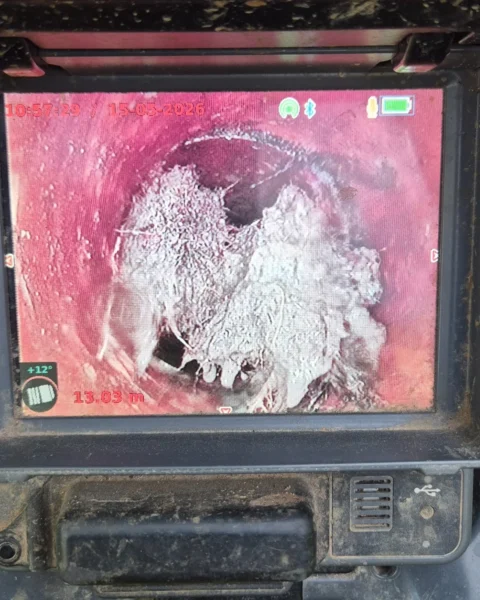
The CCTV showed:
• cracked terracotta;
• a section of pipe missing;
• rough broken edges;
• substantial root intrusion;
• and water ponding inside the drain.
The damaged pipe created several conditions that could contribute to another blockage.
Roots had a direct opening into the drainage.
The broken edges also created places where toilet paper and waste could catch.
The immediate blockage had been cleared.
The structural defect had not disappeared.
What the CCTV showed
The inspection revealed a very different problem from the smaller root intrusion seen farther upstream. Here, the pipe had structural damage, including broken terracotta and a substantial opening where roots could enter the drain.
Parkdale job photo: this is the damaged boundary-trap area identified during the original CCTV inspection. This is the same section of sewer drain that later reblocked and was subsequently excavated and replaced.
Why the Ponding Water Concerned Us
A sewer drain relies on gravity.
Wastewater needs sufficient fall to continue travelling toward the authority sewer.
When an underground pipe loses support, moves or drops, part of the drain can begin holding water instead of draining completely.
That standing water is commonly referred to as ponding.
The CCTV showed water sitting around the damaged section near the boundary trap.
Damaged underground drainage can allow wastewater to escape into the surrounding ground. Where supporting material is lost around a damaged section, this can contribute to movement, loss of alignment or gradient, and ponding. Solids and toilet paper can then collect in the low section and increase the likelihood of blockage.
When we later excavated the defect, the surrounding soil was noticeably wet.
That was consistent with what we had already seen on the CCTV: a badly damaged section where wastewater had a pathway out of the pipe.
The pre-excavation CCTV remained our strongest evidence of the pipe condition before the ground was disturbed.
Does Finding Tree Roots Mean the Whole Sewer Needs Replacing?
No.
This is an important distinction, especially in older Melbourne homes with terracotta drainage.
Tree roots tell us that roots have found moisture and an opening into the drain.
But the correct response depends on:
• where they are entering;
• how severe the intrusion is;
• whether the pipe remains structurally sound;
• whether the joints are aligned;
• and whether the drainage still has appropriate fall.
If we find small roots around ageing joints but the drain remains structurally serviceable, a complete sewer replacement may not be justified.
That was the case with several upstream joints on this Parkdale property.
The serious failure was concentrated in one area near the boundary trap.
Our aim is not to replace an old sewer simply because it is old.
Where appropriate, a targeted sectional repair can remove the failed portion while allowing serviceable upstream terracotta drainage to remain in operation.
The remaining older drain can then be monitored and maintained, including periodic root cutting if required.
For drainage with known minor root intrusion, we may recommend periodic inspection and maintenance rather than immediate full replacement.
Locating the Defect From Above Ground.
Seeing the defect on the CCTV monitor was only part of the job.
Before quoting the excavation, we needed to know:
• exactly where the defect was located;
• and approximately how deep it was.
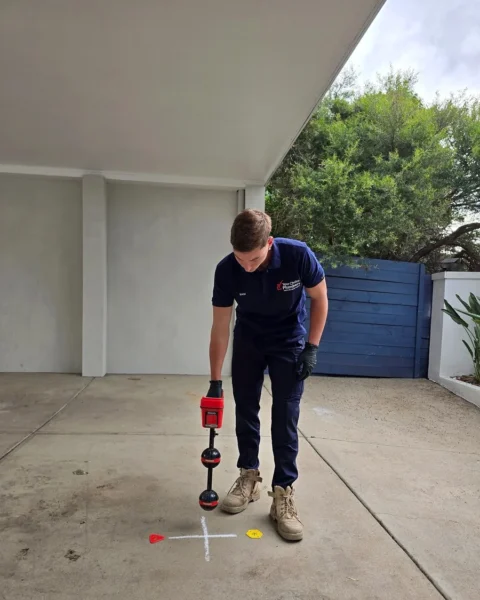
With the camera head positioned at the damaged section, we activated the 512 Hz sonde in our RIDGID SeeSnake camera system.
Using a compatible locator above ground, we could trace the transmitting camera head and determine its approximate position and depth.
We then marked the location at the surface.
That gives us a much more accurate repair scope.
The sequence becomes:
clear → inspect → identify → locate → determine depth → mark → quote the repair
This is one of the major advantages of combining CCTV drain inspection with underground locating when a blockage keeps returning
What the locating equipment confirmes
With the CCTV camera head positioned at the damaged section, we activated the 512 Hz sonde in the RIDGID SeeSnake camera system.
Using a compatible underground locator above ground, the plumber could detect the sonde signal, trace the camera head’s position and estimate the depth of the defect before excavation.
Example shown: underground locating equipment used to detect the CCTV camera head’s sonde signal and identify the drain defect from the surface.
Why We Recommended a Local Repair — Not a Whole New Sewer
By this stage, we had already inspected the remaining upstream terracotta drainage.
Yes, there were some smaller roots around old joints.
But we did not find the same severe structural failure throughout the entire sewer line.
The major defect was concentrated around the boundary-trap and lead-in area.
So we did not recommend excavating and replacing the entire terracotta sewer.
We recommended a targeted repair of the failed section, including the affected boundary-trap and lead-in arrangement.
That distinction matters.
A homeowner should not automatically be told that an entire old sewer must be replaced simply because some minor root intrusion is present.
But the opposite is also true.
A structurally damaged drain should not be described as permanently repaired simply because a jetter has restored water flow.
The CCTV evidence should determine the scope
The Drain Blocked Again About Three Weeks Later.
We showed the homeowner the CCTV footage and explained the defect.
The drain was flowing normally again and we provided a repair quotation.
The homeowner decided to monitor the drain rather than proceed with the structural work immediately.
The damaged section remained underground.
The missing piece of terracotta remained open to further root growth, and the rough edges could continue catching toilet paper and waste.
Approximately three weeks later, the main drain blocked again.
It blocked in the same defective area.
We had to clear the drainage again before the structural repair could be completed.
It was a real-world example of the difference between:
clearing the blockage
and
repairing what caused it
Repairing the Damaged Sewer Drain
The structural repair was completed in November 2025.
Because the work involved below-ground sanitary drainage, the appropriate connection documentation and inspection process had to be organised before the repaired drainage was covered.
The required permits were obtained and the below-ground drainage inspection was arranged.
The work could then be completed and left exposed for inspection before backfilling.
The Defect Was More Than 1.5 Metres Underground
The damaged drainage was more than approximately 1.5 metres below ground level, so mechanical excavation was required.
Working around an old terracotta boundary trap at that depth requires care.
The existing drainage ultimately connects to the authority sewer, so the retained downstream connection needs to be protected during excavation.
Old boundary-trap assemblies have substantial concrete beneath and around them for support.
Before removal, we exposed the old boundary-trap assembly and deliberately cut it at both ends: at the retained downstream connection toward the authority sewer, and upstream beyond the damaged area near the lead-in junction. This prevented the excavator from pulling against the old assembly and reduced the risk of damaging sound terracotta pipework we intended to retain.
This is another reason why the CCTV inspection performed before excavation was so valuable.
It documented the defect before we disturbed the area.
What We Found When We Excavated.
Once we reached the damaged section, there was significant moisture in the surrounding soil.
That was consistent with the CCTV findings.
The terracotta was badly damaged and part of the pipe was missing.
The condition of the ground around the pipe supported our concern that wastewater had been escaping from the defective section.
It also reinforced why proper pipe bedding and support would be important when rebuilding the drainage.
Protecting the Terracotta We Were Keeping
We were only replacing the failed section.
Before removing the old boundary-trap arrangement, we exposed the existing drainage at both ends.
That included:
• the downstream connection toward the authority sewer;
• and approximately one metre of the upstream terracotta drain running back toward the house.
Rather than allowing the excavator to pull against the entire old assembly, we made controlled cuts through the earthenware using a 4-inch grinder.
This reduced the chance of damaging the sections we intended to retain.
After cutting, we carefully smoothed the exposed terracotta edges before connecting the new drainage.
Why?
Because a sharp or irregular edge inside a sewer can create another point where toilet paper and waste can catch.
Installing the New Boundary Trap and Lead-In
The damaged earthenware section was replaced with new 100 mm DWV uPVC drainage pipe and fittings.
The rebuilt assembly included:
• flexible earthenware-to-uPVC transition couplings;
• inspection openings;
• the new boundary-trap arrangement;
• a replacement lead-in junction;
• approximately one metre of straight new drainage connecting back to the retained terracotta;
• a new riser;
• and a vented cap above ground.
This is the type of structural drainage work covered by our sewer drain repair and replacement service.
Video 2 — Parkdale Sewer Drain Repair
Video 2 shows the repair itself:
• excavation of the old drainage;
• exposing the pipe sections we intended to retain;
• controlled cutting of the terracotta;
• removal of the damaged boundary-trap assembly;
• preparation of the excavation;
• and installation of the new uPVC boundary trap and lead-in.
Together, the two videos tell the complete story.
Video 1: Why did the drain keep blocking?
Video 2: How was the structural defect repaired?
Why Bedding and Support Matter
A good sewer repair is not simply about connecting new pipe.
The drainage also needs continuous support.
On this job we used 7 mm screenings or quarter-minus drainage material, beneath and around the new pipework.
Particular attention was given to the lead-in junction and the sections connecting the new uPVC drainage back to the retained sewer.
We did not want voids beneath the fittings.
If a junction or pipe section is left inadequately supported, the weight of backfilled soil can place unnecessary stress on the new pipework and increase the risk of movement, deformation or cracking over time.
We also kept bricks, rocks and other hard excavation debris away from the new pipework.
The principle is straightforward:
support the drain properly before you bury it.
Correct Fall Is Just as Important as New Pipe
A brand-new repaired section can still perform poorly if it is installed with inadequate fall or does not align properly with the existing drainage system.
Sanitary drainage relies on gravity.
So when rebuilding this section, we were paying attention not only to the new fittings but also to how the replacement pipe aligned with the existing drainage at both ends.
This was especially important around the lead-in junction and boundary trap.
Remember what the CCTV showed before excavation:
water ponding inside the failed section.
The objective was not simply to replace terracotta with plastic.
It was to rebuild the section with appropriate:
• alignment;
• support;
• and fall.
Why the Repair Was Left Exposed for Inspection
Once underground drainage is backfilled, most of the workmanship disappears from view.
That is why the repaired section was left exposed for the required inspection.
Depending on the work, an inspector may examine items such as:
• the boundary trap;
• drainage materials and fittings;
• bedding and support;
• gradient;
• alignment;
• inspection openings;
• concrete support;
• ventilation;
• and connection details.
Only after the required inspection and testing process is completed can the excavation be backfilled and the job finished.
Leaving the drainage exposed allows the inspector to assess installation details that would no longer be visible once the excavation is backfilled.
Why We Didn’t Run the CCTV Camera Through the Whole Drain Again
A complete post-repair CCTV survey is not automatically necessary after every local repair.
We had already inspected the upstream drainage before excavation.
We knew the condition of the pipe sections we were retaining.
The failed section was then physically exposed, removed and rebuilt.
The replacement drainage could be inspected before it was buried, and normal flow was confirmed afterwards.
In this situation, another complete CCTV survey would not necessarily have answered a new question. CCTV is a diagnostic tool.
We use it when it helps us make a decision or confirm something that cannot otherwise be seen.
Why Drainage Compliance Matters
Below-ground sanitary drainage needs to be installed correctly because once it is covered, repairing installation problems can mean excavating the area again.
That is why this type of work involves documentation, inspection and testing before backfilling.
Installation problems such as:
• inadequate gradient;
• poor alignment;
• inadequate pipe support;
• missing inspection openings;
• or unsuitable fittingscan become expensive underground problems later.
The homeowner may never see those details once the excavation has been restored.
But those details can make a significant difference to how well the drainage performs over time.
When Should a Recurring Blocked Drain Be CCTV Inspected?
A recurring blocked drain should usually be CCTV inspected when the same drain blocks more than once, especially if the blockage appears to return in the same section of pipe.
One blockage does not automatically mean the drain is broken. But when the same drain keeps blocking — particularly in the same area — it is worth asking why.
After repeated blockages, continuing to clear the line without investigating the cause can become an expensive cycle.
A sensible diagnostic process is:
clear the blockage → clean the drain properly → CCTV inspect → identify defects → locate anything significant → decide what actually needs repairing
Sometimes the answer is cleaning and monitoring.
Sometimes a local repair is appropriate.
And sometimes more extensive replacement really is necessary.
The camera evidence should help determine which one
What Should You Ask After Your Drain Has Been Cleared?
If you have experienced recurring blocked drains, useful questions include:
• Was the blockage simply opened, or was the pipe thoroughly cleaned?
• Was CCTV used once there was enough visibility to inspect properly?
• Could the plumber clearly see the pipe walls and joints?
• Were tree roots found?
• Where were the roots entering?
• Was cracking visible?
• Were any joints displaced?
• Was part of the pipe missing?
• Was water ponding inside the drain?
• If a structural defect was found, was it located from above ground?
• Was a repair actually recommended, or only another clean?Those answers are more useful than simply hearing:
“It’s flowing now.”
How We Confirmed It Was the Main Drain — Not Just the Toilet
The homeowner had only moved into the Parkdale property a couple of days earlier.
The initial problem appeared to be a blocked toilet. When flushed, the water rose in the bowl and then slowly drained away.
Our first job was not to assume the toilet itself was blocked.
We needed to determine whether the restriction was:
• inside the toilet or toilet S-bend; or
• farther downstream in the property’s main sewer drain.
If only one toilet is affected, a common cause can be excessive toilet paper or waste caught around the toilet trap before it reaches the drain connection.
In that situation, plunging or toilet-auger equipment may be all that is required.
So we checked the other nearby fixtures.
We ran the bath and basin. Both appeared to drain normally.
Then we went outside and inspected the overflow relief gully, or ORG, beside the bathroom wall.
An ORG provides an external relief point for the sanitary drainage system if wastewater backs up. From a homeowner’s point of view, it is an important diagnostic location because an overflowing ORG can show that the problem is not simply confined to one toilet.
On this job, the ORG was overflowing.
That changed the diagnosis.
Rather than treating the problem as a simple blocked toilet, we now knew wastewater was backing up in the main drainage system.
The next question became:
Where along the main drain was the blockage?
CCTV Is Like an Endoscopy for a Sewer Drain
We sometimes describe CCTV drain inspection to homeowners as being similar to an endoscopy.
You cannot accurately judge the internal condition of an underground sewer by looking at the ground above it.
A camera allows us to travel through the drain and inspect what is actually happening inside.
It can reveal:
• tree roots;
• debris;
• cracks;
• displaced joints;
• missing pipe;
• ponding;
• collapse;
• and other structural defects.
But CCTV can also show something equally valuable:
sections of an old drain that do not need replacing.
That helps us avoid both extremes:
under-repairing a real structural failure
and
replacing serviceable drainage unnecessarily.
What This Parkdale Job Taught Us
This job started with a toilet that appeared to be blocked.
The overflowing ORG told us the problem was actually in the main drain.
The boundary trap then helped us narrow the restriction to the main drain run between the house and the boundary-trap shaft.
High-pressure jetting restored flow.
CCTV then showed tree-root intrusion — but it also revealed the bigger problem:
• cracked terracotta;
• a missing pipe section;
• rough broken edges;
• root intrusion;
• and water ponding near the boundary-trap area.
Further upstream, we found smaller root intrusion around ageing terracotta joints, but not the same level of structural failure.
That is why we recommended a targeted repair, not a complete sewer replacement.
When the repair was delayed, the drain blocked again at the same location approximately three weeks later.
And that brings us back to the main point:
A drain can be flowing again and still not be fixed.
When a blocked drain keeps returning, the most useful question may not be:
“Can you unblock it?”
It may be:
“Why does it keep blocking?”
Frequently Asked Questions About Recurring Blocked Drains
Why does my blocked drain keep coming back?
A blocked drain can keep coming back when the drain has been cleared but the underlying cause remains inside the pipe.
Common causes include tree roots, cracked pipes, displaced joints, missing pipe sections, poor fall, a collapsed section of pipe, ponding water or another defect that continues catching toilet paper and waste. Clearing restores flow, but CCTV drain inspection may be needed to confirm whether a structural problem remains.
Does hydro jetting permanently fix a blocked drain?
High-pressure hydro jetting can clear roots, waste and debris from inside the pipe and restore flow, but it does not permanently fix a structural defect.
If the pipe has cracked terracotta, a missing section, poor fall, ponding water or a displaced joint, the blockage can return until the defect is repaired. On this Parkdale job, the jetter restored flow, but the damaged section remained underground. The drain then blocked again in the same defective area about three weeks later.
When does a blocked drain need repair instead of another unblock?
A blocked drain may need repair instead of another unblock when CCTV inspection confirms a structural problem, not just a soft blockage.
Warning signs include cracked pipe, missing pipe sections, rough broken edges, displaced joints, a collapsed section of pipe, significant ponding or a defect that allows tree roots to keep entering. In those situations, another clean may restore flow temporarily, but sewer drain repair and replacement may be needed to address the actual cause.
How can a plumber tell whether the toilet or the main drain is blocked?
A plumber can often tell by checking whether other fixtures are draining normally and by inspecting external drainage points such as the overflow relief gully.
On this Parkdale job, the overflowing overflow relief gully showed that wastewater was backing up in the main drainage system, rather than the problem being confined to the toilet itself.
What does the boundary trap tell a plumber during a blocked drain diagnosis?
The water level in the boundary-trap shaft can help a plumber narrow down where the blockage is located.
On this Parkdale job, the overflow relief gully was overflowing while the boundary trap remained at its normal level. That helped us isolate the problem to the main drain run between the house and the boundary trap.
Do tree roots always mean my sewer needs replacing?
No — tree roots do not always mean the entire sewer needs replacing.
Minor root intrusion around ageing terracotta joints does not automatically mean a full sewer replacement is required. The recommendation should depend on the structural condition of the pipe, alignment, pipe fall, water ponding and the severity of the defects found.
Should CCTV always be used before high-pressure jetting?
No — CCTV does not always need to be used before high-pressure jetting.
If the drain is completely backed up with wastewater, debris or sewage, visibility may be too poor for the camera to provide useful information. In that situation, part of the blockage may need to be cleared first so the drain can discharge and the camera can see the pipe properly.
However, CCTV and jetting can sometimes be used together, depending on the access point and where the blockage is located. For example, if suitable access is available through a boundary trap or lead-in connection and the downstream pipe is clear, the plumber may be able to use the camera to help identify the blockage location before or during targeted jetting.
The right sequence depends on access, water level, visibility and what the camera can actually see.
Why can a drain block again only weeks after being cleared?
A drain can block again only weeks after being cleared if the underlying defect was not repaired.
If a cracked pipe, missing section, poor fall, ponding, displaced joint or root entry point remains, toilet paper, roots and waste can begin catching in the same area again.
On this Parkdale job, the main drain blocked again at the same defective location approximately three weeks after the initial clearing.
Does an old terracotta sewer always need replacing?
No — an old terracotta sewer does not always need replacing.
Age alone is not a reason to replace an entire sewer. The recommendation should be based on what the CCTV inspection and other site evidence show about the actual condition, alignment, fall and structural integrity of the drainage.
Can a plumber locate a sewer defect before digging?
Yes — a plumber can often locate a sewer defect before digging by using CCTV equipment with a transmitting sonde and a compatible locator.
The camera head can be tracked from above ground, allowing the plumber to estimate the defect’s position and approximate depth before excavation. This helps reduce unnecessary digging and supports a more targeted repair.
Is clearing a blocked drain the same as repairing it?
No — clearing a blocked drain is not the same as repairing it.
Clearing removes the immediate obstruction and restores flow. Repairing addresses a confirmed defect in the drainage itself, such as cracked pipework, displaced joints, missing pipe sections, poor fall, ponding or root entry points.
Related drain diagnosis and sewer repair examples
Need Help With a Recurring Blocked Drain in Melbourne?
If your drain has already been cleared but keeps blocking again, another temporary clear may not give you the full answer.
Your Choice Plumbers can combine high-pressure drain cleaning with CCTV inspection and underground locating where appropriate to determine what is actually happening inside the drainage.
If structural damage is found, we can then determine whether the appropriate solution is:
• monitoring and maintenance;
• a targeted sewer drain repair;
• or more extensive replacement.
For broader service information, visit our blocked drains Melbourne page. You can also visit our plumber Parkdale page for local plumbing services.
Call Your Choice Plumbers on 1300 852 779 or book a service online.
Your Choice Plumbers — Melbourne’s Trusted Home Plumbing Experts.
Expert Repairs. Future Prevention. Lasting Results.